

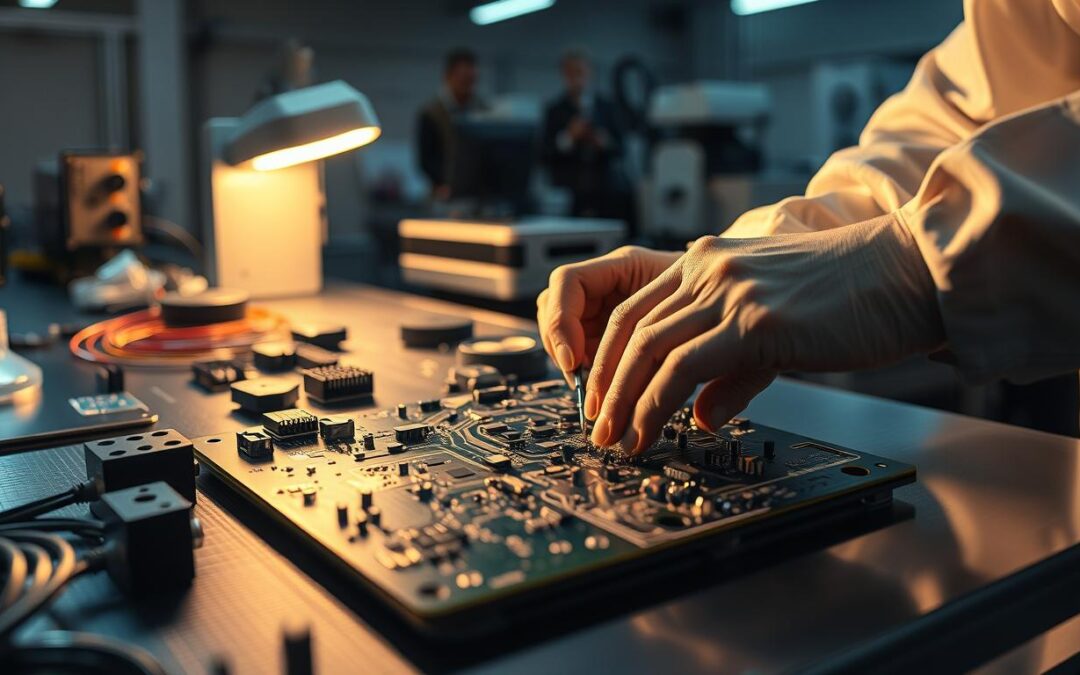
You need a quick and reliable service to make your PCB assembly prototype real. With the rush for fast electronic designs, a rapid pcb prototype assembly service is key.
Did you know a lot of time in product development is spent on making prototypes? Our service can greatly reduce this time. This means you can get your product to market sooner.
We aim to give you a top-notch prototype fast. This way, your project can keep moving without delays. Our focus on speed and reliability helps you meet your development goals quickly.
What is a PCB Assembly Prototype?
A PCB assembly prototype is a first version of your printed circuit board assembly. It’s used to test and validate your design. This step helps find and fix any issues before making a large number of boards.
Definition and Importance
A prototype circuit board assembly is a first version of a printed circuit board assembly. It’s used for testing and validation. This step is key in the development process, letting you check if your design works as planned.
Having a prototype lets you test the functionality, performance, and reliability of your PCB assembly. It’s vital to ensure your final product meets all the required standards and quality.
Types of PCB Prototypes
There are several types of PCB prototypes, each with its own purpose in the development process. The main types include:
- Functional Prototype: Used to test the functionality of the PCB assembly.
- Visual Prototype: Focuses on the appearance of the PCB assembly, used for design verification.
- Form, Fit, and Function Prototype: Tests the form, fit, and functionality of the PCB assembly, ensuring it meets all design requirements.
Knowing the different types of prototypes helps you pick the right one for your needs. This makes your development process more efficient and effective.
| Type of Prototype | Purpose | Key Features |
|---|---|---|
| Functional Prototype | Test functionality | Electronic components, PCB layout |
| Visual Prototype | Verify design appearance | Aesthetic features, PCB design |
| Form, Fit, and Function Prototype | Test form, fit, and functionality | Electronic components, mechanical fit, PCB layout |
Benefits of PCB Assembly Prototypes
PCB assembly prototypes help you save money and get your product to market quickly. They let you test and improve your design before making a lot of products.
Cost-Effectiveness
Using a quick turn prototype pcb assembly saves you money. You can spot and fix design problems early, avoiding expensive fixes later.
This approach saves money in several ways. It reduces material waste and lowers labor costs because you need fewer design changes.
| Cost Component | Without Prototype | With Prototype |
|---|---|---|
| Material Costs | $10,000 | $8,000 |
| Labor Costs | $5,000 | $3,000 |
| Total Cost | $15,000 | $11,000 |
Speed to Market
An affordable pcb assembly prototype speeds up your product development. It lets you test and confirm your design, making it easier to get funding or start production.
In today’s fast-paced market, getting your product to market quickly is key. A prototype helps you do this, giving you an edge over competitors.
By using PCB assembly prototypes, you can make your product development better, save money, and get to market faster.
Understanding the PCB Assembly Process
Creating a high-quality PCB assembly prototype involves several key steps. You need to understand the process involved in its creation. This ensures your final product meets your specifications and is reliable.
Design Phase
The design phase is where your PCB assembly prototype begins to take shape. You will work closely with engineers to create a design that meets your requirements. This stage involves schematic capture, where the circuit is designed, and PCB layout, where the components are placed on the board.
During the design phase, it’s important to consider several factors. These include signal integrity, power delivery, and thermal management. You should also ensure that your design complies with the relevant standards and regulations.
Material Selection
Material selection is a critical aspect of the PCB assembly process. You need to choose materials that are compatible with your design and meet the required specifications. This includes selecting the right substrate material, such as FR4 or Rogers, and choosing the appropriate copper thickness.
The choice of materials can significantly impact the performance and reliability of your PCB assembly prototype. You should consider factors such as dielectric constant, thermal conductivity, and moisture absorption when making your selection.

Manufacturing Methodologies
The manufacturing methodologies used for your PCB assembly prototype can vary depending on your requirements. Common methodologies include Surface Mount Technology (SMT) and Through-Hole Technology (THT).
You should work closely with your manufacturer to determine the best approach for your project. They can help you navigate the complexities of the manufacturing process. This ensures that your prototype is produced to the required standard.
By understanding the PCB assembly process, you can ensure that your prototype is manufactured to the highest quality standards. This involves careful planning, precise execution, and a thorough understanding of the factors that affect the final product.
Key Considerations for Your PCB Prototype
When you order a PCB prototype, several important factors must be considered. This ensures your product meets the necessary standards.
Success in your PCB prototype depends on careful planning and attention to detail. Here are the main considerations:
Design Specifications
Your design specifications are the blueprint for your PCB prototype. It’s vital to make sure these are accurate and complete.
- Define your PCB’s dimensions and layout.
- Specify the materials and components to be used.
- Determine the PCB’s layer stack-up and configuration.
Clear design specifications help prevent misunderstandings and errors during the manufacturing process.
Testing Requirements
Testing is a critical phase in the development of your PCB assembly prototype. You need to identify the types of tests your prototype will undergo.
- Functional testing to ensure the PCB operates as intended.
- Environmental testing to assess durability under various conditions.
- Signal integrity testing to verify the quality of signal transmission.
Rigorous testing helps identify and rectify issues early, saving time and resources.
Compliance with Standards
Compliance with industry standards is not just about avoiding legal issues; it’s also about ensuring your product’s reliability and market acceptance.
- Identify relevant standards for your industry and application.
- Ensure your PCB assembly prototype meets these standards.
- Obtain necessary certifications.
Compliance enhances your product’s credibility and can be a significant selling point.
Choosing the Right PCB Assembly Service
Finding a trustworthy PCB assembly service is key to making your prototype a reality. The success of your project depends on the service provider’s skills and reliability.
When looking at fast PCB assembly services, check their prototype circuit board assembly experience. Choose a manufacturer known for quick, high-quality prototypes.
Evaluating Service Providers
To pick the best PCB assembly service for you, consider these points:
- Look at their technical skills and tools
- Check their quality control steps
- See if they have the right certifications and follow industry standards
- Assess their customer service and how they communicate
What to Look for in a Protoboard Manufacturer
A good protoboard manufacturer should have:
- Modern manufacturing tech
- Ability to handle various project sizes and complexities
- Clear pricing
- Strong testing and inspection methods
Customer Support and Communication
Good customer support is vital for a smooth project. Your PCB assembly service should offer:
- Quick and easy communication channels
- Regular updates on your project
- Clear reports and documentation
- A single contact for your project
By carefully checking fast PCB assembly services against these criteria, you can make sure your prototype circuit board assembly is well taken care of. This will lead to a successful project.
Common Challenges in PCB Assembly Prototyping
When you start quick turn prototype PCB assembly, you’ll hit some common hurdles. Knowing these challenges helps make your prototyping smoother and faster.
Design Errors
Design mistakes are a big problem in PCB assembly prototyping. These can be simple mistakes or complex issues with signal integrity. To avoid these errors, it’s key to:
- Use strong design software with checks and validation
- Follow best practices for PCB design, like proper spacing and grounding
- Have your design checked by skilled engineers before making prototypes
Supply Chain Issues
Problems with the supply chain can really mess up your rapid PCB prototype assembly. These issues might include component shortages, delays, or quality problems with suppliers. To deal with these risks, think about:
- Choosing suppliers known for their reliability
- Setting up a solid supply chain management system
- Finding backup components or suppliers for when things go wrong
Here’s a quick look at how these challenges can affect your project:
| Challenge | Potential Impact | Mitigation Strategy |
|---|---|---|
| Design Errors | Delays in prototyping, higher costs | Strong design software, design reviews |
| Supply Chain Issues | Project delays, component shortages | Reliable suppliers, supply chain management |

By knowing these common challenges and how to tackle them, you can make your PCB assembly prototyping projects more efficient and successful.
Tips for a Successful PCB Prototype Development
To make sure your PCB assembly prototype is made well, follow these important tips. A good PCB prototype needs a solid design, the right materials, and working with skilled engineers.
Prototyping Best Practices
Good practices in PCB prototyping can really help your project. Start by designing for manufacturability. This means your PCB design should work well with the making process. Think about trace width, via size, and where to place components.
- Use design software that fits with your manufacturer’s needs.
- Make sure your design files are complete and right.
- Choose materials based on what your project needs.
Also, prototype in stages. Start with simple designs and get more complex as you go. This way, you can find problems early.
Collaboration with Engineers
Working with experienced engineers is key for a great PCB prototype. They can give you tips on design optimization, picking components, and testing. By teaming up with engineers, you can make sure your PCB prototype is up to standard and ready for production.
When working with engineers, remember to:
- Tell them clearly what you need and expect.
- Give them all the design files and details.
- Listen to their feedback and ideas for bettering your design.
By following these tips and working with skilled engineers, you can make a successful PCB assembly prototype. This will give you an affordable pcb assembly prototype that fits your needs.
Real-World Applications of PCB Prototypes
PCB prototypes are key in making new products in many fields. They help test and improve your designs before making lots of them.
Electronics and Consumer Goods
In the world of electronics and consumer goods, PCB prototypes are vital. They help make everything from phones and laptops to kitchen gadgets. These tests check if your products work well and last long, making sure they’re good for customers.
Some important uses include:
- Smart home devices
- Wearable technology
- Gaming consoles
Automotive Industry
The car world also needs PCB prototypes for new car systems. These include:
- Infotainment systems
- Navigation systems
- Advanced driver-assistance systems (ADAS)
Having a top-notch PCB prototype is key for these systems to work right.
| Industry | Application | Benefits of PCB Prototypes |
|---|---|---|
| Electronics and Consumer Goods | Smartphones, Laptops, Home Appliances | Functionality testing, Durability testing |
| Automotive | Infotainment Systems, Navigation Systems, ADAS | Reliability, Performance testing |
Using a PCB prototype company speeds up making your product. It makes sure your final product works well and is efficient.
Future Trends in PCB Assembly Prototyping
The future of PCB assembly prototyping is changing. Sustainability and new technologies are leading the way. You’ll see more eco-friendly practices in PCB making.
Eco-Friendly Manufacturing Practices
Reducing waste and using recyclable materials are key. Fast pcb assembly services will get greener. This makes production better for the planet.
Technological Advancements
New tech will change how we make PCB prototypes. Look for better automation, AI in design, and new testing methods. These will make production faster, cheaper, and better quality.
By following these trends, you can lead the way. Your products will be top-notch and good for the environment. The industry will keep growing, and you’ll find new ways to succeed.
FAQ
What is a PCB assembly prototype, and why is it necessary?
A PCB assembly prototype is a first version of your printed circuit board. It’s used to test and validate your design before making many copies. It helps find and fix problems early, ensuring everything works right.
How long does it take to get a PCB assembly prototype?
The time to get a PCB assembly prototype varies. It depends on the design’s complexity, the manufacturer’s workload, and shipping. You can usually get it in a few days to weeks.
What are the benefits of using a PCB assembly prototype service?
Using a PCB assembly prototype service saves time and money. It helps find and fix design issues early. This reduces costly rework and speeds up your product’s launch.
How do I choose the right PCB assembly service provider for my prototype?
When picking a PCB assembly service provider, look at their experience and capabilities. Check their quality control, customer support, and prices. Choose one that offers fast and high-quality prototype assembly.
What are the key considerations when ordering a PCB prototype?
When ordering a PCB prototype, think about design specs and testing needs. Make sure your design is easy to make and work with a reliable manufacturer.
How can I ensure the quality of my PCB assembly prototype?
To ensure quality, work with a reputable manufacturer. They should have a strong quality control process. Inspect and test your prototype well to confirm it works.
What are some common challenges in PCB assembly prototyping, and how can I mitigate them?
Common challenges include design errors, supply chain issues, and manufacturing defects. To avoid these, work with experienced engineers and review your design carefully. Choose a reliable manufacturer with good customer support.
Can I get a quick turn prototype PCB assembly for my project?
Yes, many providers offer quick turn prototype PCB assembly. This can help you get your prototype fast. Make sure to pick a provider that fits your needs and timeline.
How do advancements in technology impact PCB assembly prototyping?
Advances in technology improve PCB assembly prototyping quality and efficiency. Keep up with new developments to use the latest capabilities and best practices.