


You’re searching for a solid way to link your integrated circuits to your printed circuit board. Ball Grid Array technology is a top choice. It allows for more connections in a smaller area.
Advanced PCB connection technology boosts performance and reliability. Repro Supplies in Boksburg, South Africa, provides top-notch PCB services using this tech. For details, reach out to them at info@reprosupplies.co.za or +27 11 826 5364.
Using Ball Grid Array (BGA) tech can make your electronic systems better and more efficient. It’s great for systems that need lots of connections but have little space.
What is a Ball Grid Array?
You know how important reliable connections are in electronic devices. Ball Grid Array (BGA) technology is key to this. It’s a surface-mount packaging with small solder balls on the underside. These balls connect to the PCB.
Definition and Basic Concept
A Ball Grid Array has a grid of solder balls that link the device to the PCB. This setup is great for complex systems. It’s perfect for devices like microprocessors, where the whole bottom is used for connections.
Types of BGA Packages
There are many BGA packages for different needs. Here are a few:
- Plastic Ball Grid Array (PBGA): It’s affordable and widely used.
- Ceramic Ball Grid Array (CBGA): It’s best for high-power needs because of its thermal performance.
- Tape Ball Grid Array (TBGA): It uses a tape substrate, making designs more flexible.
Repro Supplies offers top-notch BGA components for your PCB assembly. They make sure you have the right materials for your projects.
The Evolution of BGA Technology
Exploring advanced PCB connection technologies means understanding BGA evolution. BGA technology started from earlier packaging methods. It evolved to meet the need for more connections and better performance.
Historical Development
The history of BGA technology is filled with big steps forward. First, the pin grid array (PGA) was used, but it had its limits. BGA technology came along to fix these issues by using small pads and tiny solder balls.
From Pin Grid Arrays to BGAs
The move from PGA to BGA brought many improvements. Key advancements include:
- Higher connection density
- Improved thermal and electrical performance
- Reduced size and weight
With BGA technology, companies like Repro Supplies lead in PCB manufacturing. They offer you the latest solutions. BGA technology keeps getting better, thanks to ongoing research and development.
BGA Architecture and Design
To successfully integrate BGA components into your PCB assemblies, you must understand their architecture and design. A BGA package has several key parts that work together. They ensure reliable connections.
Structural Components
The BGA package includes a substrate, a die, and solder balls. The substrate is the base, often made from materials like BT resin or ceramic. It provides mechanical support. The die is the silicon chip with the electronic circuitry.
Repro Supplies uses advanced techniques and equipment for high-quality BGA soldering. This ensures your PCB assemblies are reliable.
Solder Ball Arrangement Patterns
The solder balls are arranged in a pattern on the BGA package’s underside. This pattern helps connect the package to the PCB. Common patterns include grid arrays and perimeter arrays.
The pattern choice depends on the application and needed connection density.
Substrate Materials and Properties
The substrate material is key to the BGA package’s performance. Materials like BT resin and ceramic are used for their thermal and electrical properties. BT resin balances cost and performance well.
Ceramic substrates, on the other hand, offer excellent thermal stability.

Advantages of BGA Technology
Using BGA technology can greatly enhance your PCB designs. It brings several key benefits. These include higher connection density, better thermal and electrical performance, and smaller size and weight.
Higher Connection Density
BGA packages have a higher number of connections in a smaller area. This is thanks to the grid array format. It allows more connections per unit area than traditional methods.
This makes BGA perfect for complex electronic systems. You can fit more functionality in a smaller space.
Improved Thermal and Electrical Performance
BGA technology offers better thermal performance. The direct connection of the die to the substrate improves heat dissipation. This is a big plus.
Also, the shorter electrical paths reduce signal delay. This improves the overall electrical performance. BGA is great for high-speed applications.
Size and Weight Reduction
Using BGA technology can make your electronic devices smaller and lighter. The compact nature of BGA packages saves space on the PCB. This leads to lighter and more portable products.
Repro Supplies offers expert bga assembly services. They can help you achieve these benefits in your PCB designs.
Challenges and Limitations of BGAs
While BGA technology has many benefits, it also has challenges. Manufacturers must face these issues to use BGA components successfully in their PCB designs.
Inspection Difficulties
Checking BGA solder joints is hard because they’re hidden. You can’t see them like other connections. To find problems, you need special tools like X-ray inspection.
Thermal Stress Issues
Thermal stress is a big problem for BGA components. When they heat up and cool down, the solder joints can fail. You must pick materials that handle heat well to avoid this.
Rework Complexity
Fixing BGA components is hard. You need special tools and skills to remove and replace them without damage. This makes repairs more expensive and time-consuming.
Companies like Repro Supplies use advanced methods to make sure BGA assemblies are top-notch. By knowing the challenges and how to solve them, you can get the most out of BGA technology in your designs.
| Challenge | Description | Mitigation Strategy |
|---|---|---|
| Inspection Difficulties | Hidden solder joints make visual inspection challenging | Use advanced inspection techniques like X-ray |
| Thermal Stress Issues | Thermal expansion and contraction can cause solder joint failures | Select materials with compatible thermal properties |
| Rework Complexity | Difficulty in removing and replacing BGA components without damage | Use specialized equipment and techniques for BGA rework |
The BGA Manufacturing Process
The making of BGA components is a detailed process. It needs precision and careful attention. Knowing these steps helps us see how complex BGA production is.
Substrate Preparation
The substrate is the base of the BGA package. Substrate preparation adds a solder mask layer. This protects the substrate from solder during assembly. It’s key for the BGA’s reliability.
Die Attachment Methods
The die is attached to the substrate in different ways. Die attachment is very precise. It ensures the electrical connections are right.
Solder Ball Placement Techniques
Solder balls are placed on the substrate for connections. The solder ball placement technique used is important. It affects the BGA’s reliability and performance.
| Step | Description | Importance |
|---|---|---|
| Substrate Preparation | Applying solder mask to the substrate | High |
| Die Attachment | Attaching the die to the substrate | High |
| Solder Ball Placement | Placing solder balls on the substrate | High |
If BGA components are damaged or faulty, bga rework services can help. Companies like Repro Supplies offer expert bga rework. They repair and replace BGA components, keeping your production running smoothly.
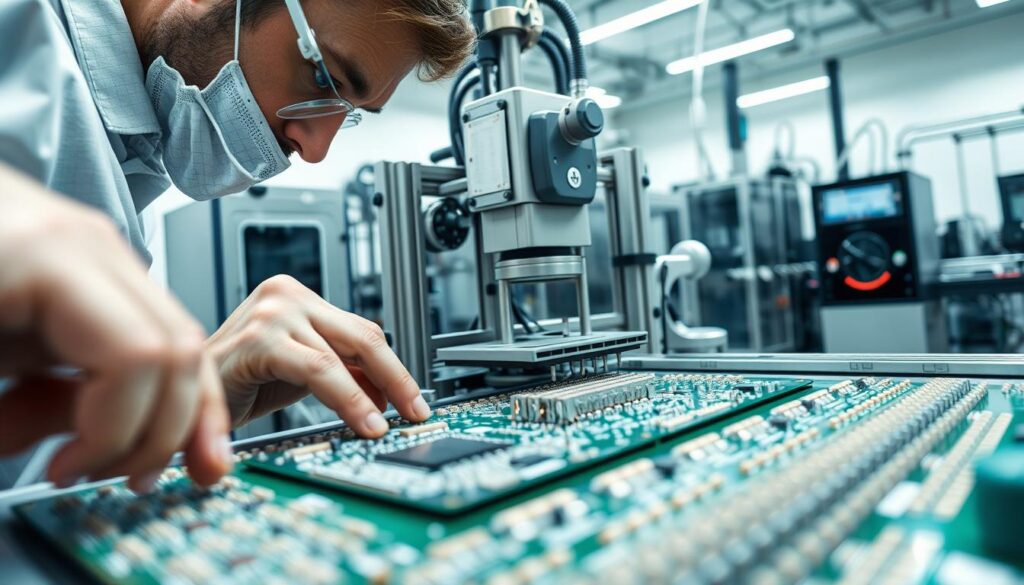
BGA Soldering Techniques and Best Practices
To get reliable BGA connections, you need to know how to solder. BGA soldering uses techniques like reflow soldering and controlling temperature. Repro Supplies keeps up with new BGA soldering methods. This ensures your PCBs are made with top quality and reliability.
Reflow Soldering Process
The reflow soldering process is key in BGA assembly. It heats the solder balls to melt them and connect them to the PCB. Proper reflow soldering makes strong and reliable connections. It’s important to control the temperature carefully to avoid damage to components or the PCB.
Temperature Profiles and Control
Temperature control is critical in the reflow soldering process. Wrong temperatures can cause solder defects or damage components. You must heat the solder balls to the right temperature for reliable connections. This means following precise temperature profiles during the reflow process.
Mastering BGA soldering techniques and best practices boosts your PCB quality and reliability. Repro Supplies is dedicated to using the latest BGA technology to fulfill your manufacturing needs.
BGA Inspection and Quality Control Methods
Ensuring the quality of BGA components is key for reliable electronic devices. Advanced inspection techniques are needed to check these components’ integrity.
X-ray Inspection Technology
X-ray inspection looks at the inside of BGA components, like solder joints. It finds defects like voids, bridging, or misalignment.
Automated Optical Inspection
Automated optical inspection (AOI) checks the surface of BGA components. AOI systems use cameras and software to spot surface defects, like missing or misaligned parts.
Common Defects and Detection Strategies
Common BGA component defects include solder joint issues, substrate warpage, and die attach problems. To find these, a mix of X-ray inspection, AOI, and other methods are used.
| Defect Type | Detection Method | Importance |
|---|---|---|
| Solder Joint Defects | X-ray Inspection | High |
| Substrate Warpage | Automated Optical Inspection | Medium |
| Die Attach Issues | X-ray Inspection | High |
Repro Supplies uses top-notch inspection methods to ensure BGA components are of high quality. This reduces the chance of defects and guarantees reliable performance.
PCB Manufacturing with BGA in South Africa
Repro Supplies leads in BGA manufacturing in South Africa. They offer top-notch PCB manufacturing services.
Industry Overview and Challenges
The PCB manufacturing sector in South Africa is expanding. BGA technology plays a big role. But, you might face high costs and need special equipment.
For these hurdles, a trusted partner is key. Repro Supplies is here to help with their BGA expertise.
Repro Supplies’ BGA Manufacturing Services
Repro Supplies provides full BGA manufacturing services. They handle substrate prep, die attachment, and solder ball placement. Their team and facilities are top-notch.
They tailor their services to fit your needs. This ensures you get quality PCBs that meet your standards.
Quality Standards and Compliance in South African Manufacturing
Repro Supplies follows strict quality standards. They ensure their PCBs meet international rules. You can count on their commitment to quality.
Choosing Repro Supplies means you’re getting reliable PCBs and services.
Applications of BGA Components in Modern Electronics
BGA components are found in many modern electronic devices. They offer high-density connections and better thermal and electrical performance. This makes them perfect for complex electronic systems.
Consumer Electronics Applications
In consumer electronics, BGA components are key. They are used in smartphones, laptops, and tablets. These components help make devices smaller, more powerful, and use less power. For example, BGA assembly leads to more compact designs, improving the user experience.
Industrial and Automotive Uses
In industrial and automotive fields, BGA components are vital. They are used in control systems and navigation systems. Their reliability and durability are key in these tough environments. BGA soldering is essential for keeping these components working well in harsh conditions.
Telecommunications and Networking Equipment
BGA components are also critical in telecommunications and networking. They enable fast data transmission and processing. Their high reliability, low latency, and high bandwidth are essential. Repro Supplies offers expert BGA assembly and soldering services. They ensure your PCBs are top-notch.
| Application Area | Key Benefits | Examples |
|---|---|---|
| Consumer Electronics | Compact design, improved performance | Smartphones, laptops, tablets |
| Industrial and Automotive | Reliability, durability | Control systems, navigation systems |
| Telecommunications and Networking | High-speed data transmission, high reliability | Networking equipment, telecommunications infrastructure |
The Future of BGA Technology in Advanced PCB Manufacturing
Are you wondering about BGA technology’s future? As we need more connections and better performance, BGA will be key in making PCBs better.
BGA tech will get better with new materials and ways to make things. Repro Supplies is always learning about these changes. They make sure customers get the newest tech.
Checking bga inspection will be more important than ever. New ways to inspect will help make sure BGA parts work well.
With bga technology getting better, we’ll see gadgets that work better and last longer. This will be true for everything from phones to cars.
FAQ
What is a Ball Grid Array (BGA)?
A Ball Grid Array (BGA) is a way to mount chips on a circuit board. It uses small solder balls on the bottom for connections.
What are the different types of BGA packages?
There are several BGA packages, like Plastic Ball Grid Array (PBGA) and Ceramic Ball Grid Array (CBGA). Each has its own features and uses.
How has BGA technology evolved over time?
BGA technology started from pin grid array (PGA) packaging. It replaced pins with small pads and solder balls. This led to more connections and reliability.
What are the key components of a BGA package?
A BGA package has a substrate, die, and solder balls. The substrate is the base, the die is the chip, and the solder balls connect to the PCB.
What are the benefits of using BGA technology?
BGA technology has many benefits. It offers more connections, better performance, and is smaller and lighter. It’s great for complex systems.
What are the challenges associated with BGA technology?
BGA technology faces challenges like hard inspections and thermal stress. It also has complex rework. Advanced techniques and tools are needed for quality.
How are BGA components manufactured?
Making BGA components involves preparing the substrate, attaching the die, and placing solder balls. It needs precise methods for quality.
What are the best practices for BGA soldering?
For BGA soldering, use reflow and control the temperature. This ensures reliable connections.
How are BGA components inspected and quality-controlled?
Inspecting BGA components uses X-ray and automated optical inspection. These methods find defects and ensure quality. Common issues include solder failures and surface defects.
What are the applications of BGA components?
BGA components are used in many areas. They’re in consumer electronics, industrial systems, and telecommunications. They offer high-density connections and better performance.
What is the future of BGA technology?
BGA technology will keep evolving. Advances in materials and manufacturing will be key. It will play a big role in PCBs as demand for more connections and better performance grows.