
Where can you get BGA inspection and testing done locally? (and what to ask for)
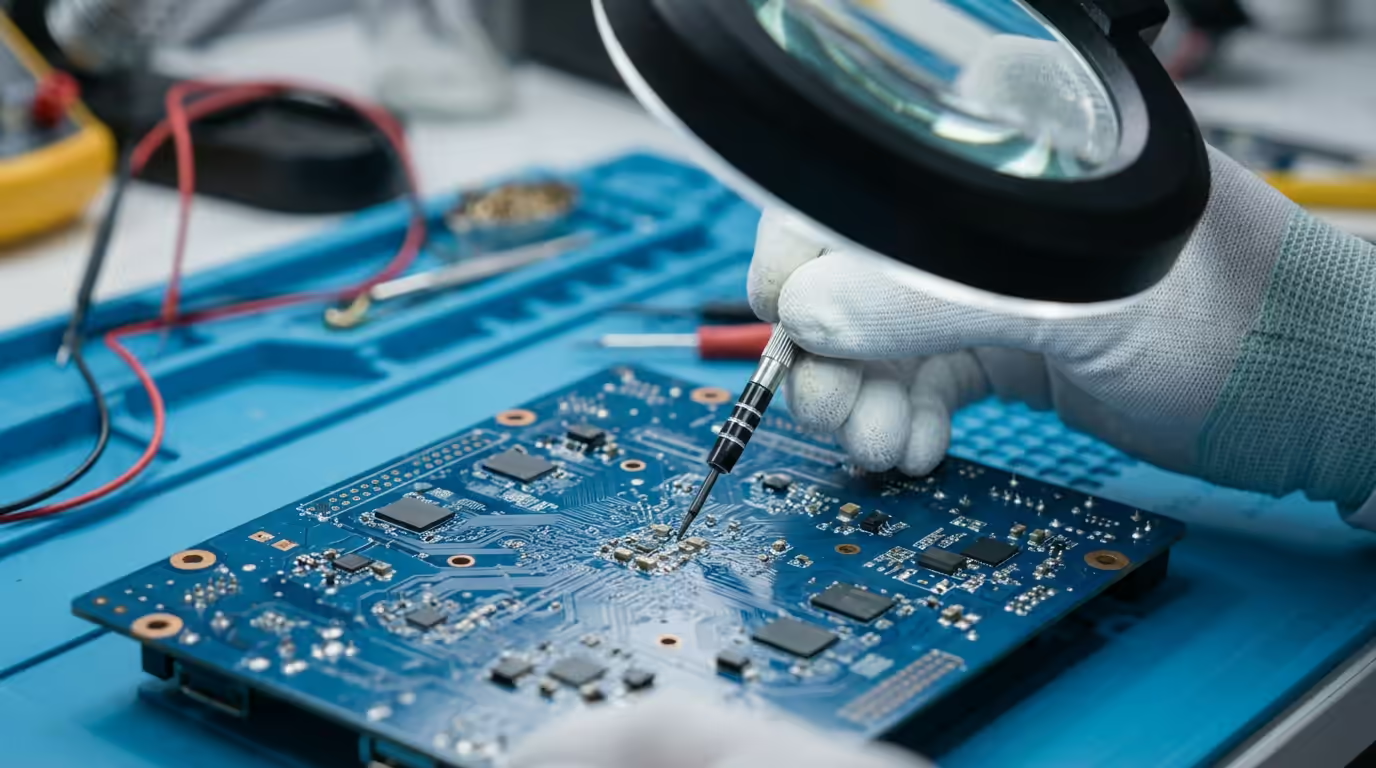
If you’re searching for BGA inspection and testing locally, you’re normally trying to confirm solder joint quality on hidden connections under a Ball Grid Array package. That usually means X-ray (2D or CT/3D) plus the right process checks and reporting so you can trust the result. IPC guidance like IPC-7095 focuses on BGA design/assembly and inspection topics, and many local labs reference IPC-aligned processes.
What “BGA inspection and testing” usually includes
1) Inspection (find defects)
Common methods you’ll see offered:
- 2D X-ray inspection
Best for: voiding, shorts/bridges, missing balls, some alignment issues - CT / 3D X-ray (computed tomography)
Best for: complex faults, layered joints, higher confidence diagnosis
- Optical / microscope inspection
Best for: surrounding components, pads, rework quality checks
- Solder paste inspection (SPI) / AOI
Usually relevant during assembly, not always for a finished board
Local service providers often market 2D X-ray and CT (3D) as in-house inspection services.
2) Testing (prove the board works)
This depends on your board and your goal:
- Functional testing (power-up tests, IO checks, comms checks)
- Boundary scan (JTAG) (good for BGA connectivity on supported designs)
- In-circuit testing (ICT) (fixture-based; often for production)
- Thermal profiling / stress screening (when failures are intermittent)
What to ask a local lab so you get a useful result
Ask these questions in writing (email/WhatsApp). It upgrades the quality of the report you receive.
A) Capability questions
-
Do you offer 2D X-ray and CT/3D?
-
What is your maximum board size and maximum component height?
-
Can you do BGA analysis (void %, bridging indicators, alignment checks)?
-
Do you handle ESD-controlled intake and storage?
B) Reporting questions
-
Will you provide:
-
Annotated images (with callouts)
-
A pass/fail statement tied to a standard
-
Void estimates (where applicable)
-
-
Which standards do you work to (examples you may see):
-
IPC-7095 (BGA process guidance)
-
IPC-A-610 (acceptability criteria used widely for assemblies)
-
J-STD-001 (soldering process requirements)
-
C) Turnaround and handling
-
What’s the turnaround for:
-
inspection only
-
inspection + rework + re-inspection
-
How to choose the right “local” option (fast decision table)
| Your situation | Best local service to look for | What you should request |
|---|---|---|
| You suspect bad joints under a BGA | 2D X-ray | Images + notes on voiding/bridging + suspected nets/area |
| Intermittent faults, hard to prove | CT / 3D X-ray | CT slices of the BGA + written conclusion |
| You need proof for a supplier dispute | X-ray + formal report | Report referencing IPC-aligned criteria + timestamped images |
| You’re in production | X-ray + AOI/SPI at assembly | Process report, defect trends, rework rate |
| You need “works/doesn’t work” | Functional test (plus X-ray if needed) | Test procedure + results log + serial tracking |
What “locally” can mean in practice
Most people mean one of these:
-
A local electronics manufacturing / rework house (often has X-ray + skilled rework techs)
-
A specialist X-ray inspection provider (often offers 2D + CT services)
-
A test and inspection equipment firm that also offers inspection services or can point you to service partners
If you tell me your city (Johannesburg / Pretoria / Durban / Cape Town), I can search for the closest options and list them.
FAQs
Q1: What is the best way to inspect BGA solder joints locally?
A: Start with a 2D X-ray. If the fault is intermittent or difficult to confirm, ask for a CT/3D X-ray.
Q2: Can a lab tell me if my BGA has “cold joints” or head-on-pillow from X-ray?
A: X-rays can show indicators like voiding and ball-shaped anomalies. Some defects still need correlation with symptoms, rework findings, or CT scans. IPC guidance covers BGA inspection and common anomalies.
Q3: Do I need testing as well as inspection?
A: If you need proof the board works, ask for functional testing. If you only need solder-joint evidence, inspection may be enough.
Q4: What should I send to the inspection company?
A: Send the PCB, a short fault description, high-resolution photos, and any board docs you can share (BOM, layout images, suspected area).
Q5: What standards should a good BGA inspection report reference?
A: Many providers align to IPC guidance such as IPC-7095 (BGA process/inspection) and IPC-A-610 (acceptability criteria) and may reference J-STD-001 for soldering requirements.
